

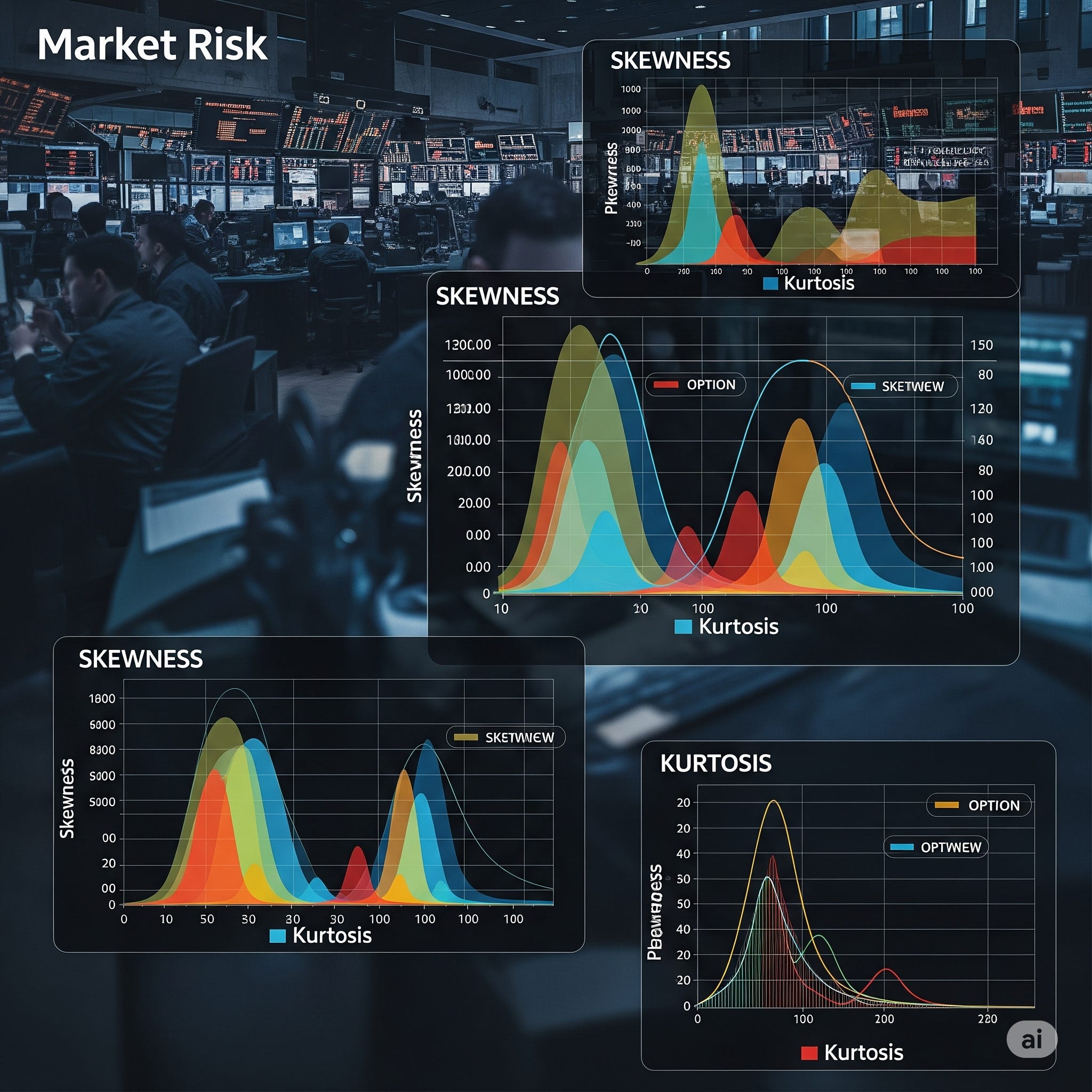
As a quantitative trader who's spent years building systematic strategies, I've learned that the market's most dangerous moments often come when you least expect them. The 2008 financial crisis, the March 2020 COVID crash, the recent banking sector turmoil—these weren't just "black swan" events. They were mathematical realities hiding in plain sight, encoded in the higher-order moments that most traders ignore.
Today, I want to share why skewness and kurtosis—the third and fourth moments of return distributions—have become the secret weapons in my trading arsenal, and how recent academic research is revolutionizing how we think about risk and return.
The Problem with "Normal" Thinking
Most traditional finance assumes returns follow a normal distribution. It's a beautiful, mathematically convenient assumption that makes portfolio optimization clean and elegant. There's just one problem: it's catastrophically wrong.
The normality of the distribution of asset returns is a common assumption in many quantitative finance models. This is a convenient assumption, as the normal distribution can be completely summarized by its mean and standard deviation/variance. But when markets crash, they don't politely follow your normal distribution assumptions.
Consider this: if stock returns were truly normal, we'd expect to see:
Market crashes of 10%+ maybe once every few decades
No persistent trends (momentum wouldn't exist)
Symmetric upside and downside moves
This is where skewness and kurtosis come in—they capture the asymmetry and tail risk that mean and variance miss entirely.
