

A 30-year reality check on sophisticated portfolio theory
Hey everyone,
Today I'm sharing the results of a backtest that humbled my investment ego. I tested what I thought was a sophisticated "barbell" portfolio strategy against boring equal-weight diversification over 30 years.
Spoiler alert: The boring approach won by 27%.
The Setup That Should Have Worked
I've been fascinated by barbell strategies lately—the idea that you concentrate risk in specific areas rather than spreading it evenly across everything. It sounds so much smarter than just dividing your money equally, right?
My test allocation:
20% GLD (gold) for inflation protection and crisis alpha
30% SPY (S&P 500) for core equity growth
50% TLT (long-term treasuries) for deflation protection and duration play
The "naive" benchmark? Just split everything equally: 33.33% each.
I was convinced the barbell would crush it. After all, I was making intelligent bets about market regimes while the equal-weight approach was just... existing.
What Actually Happened
The chart tells the whole story. Over 30 years (roughly 1995-2025), equal weight delivered about 9.5x returns while my sophisticated barbell managed just 7.5x.
For the first 13 years, both strategies moved almost identically. Through the dot-com bubble, recovery, housing boom—they were practically twins. I would've been patting myself on the back thinking my strategy was "performing as expected."
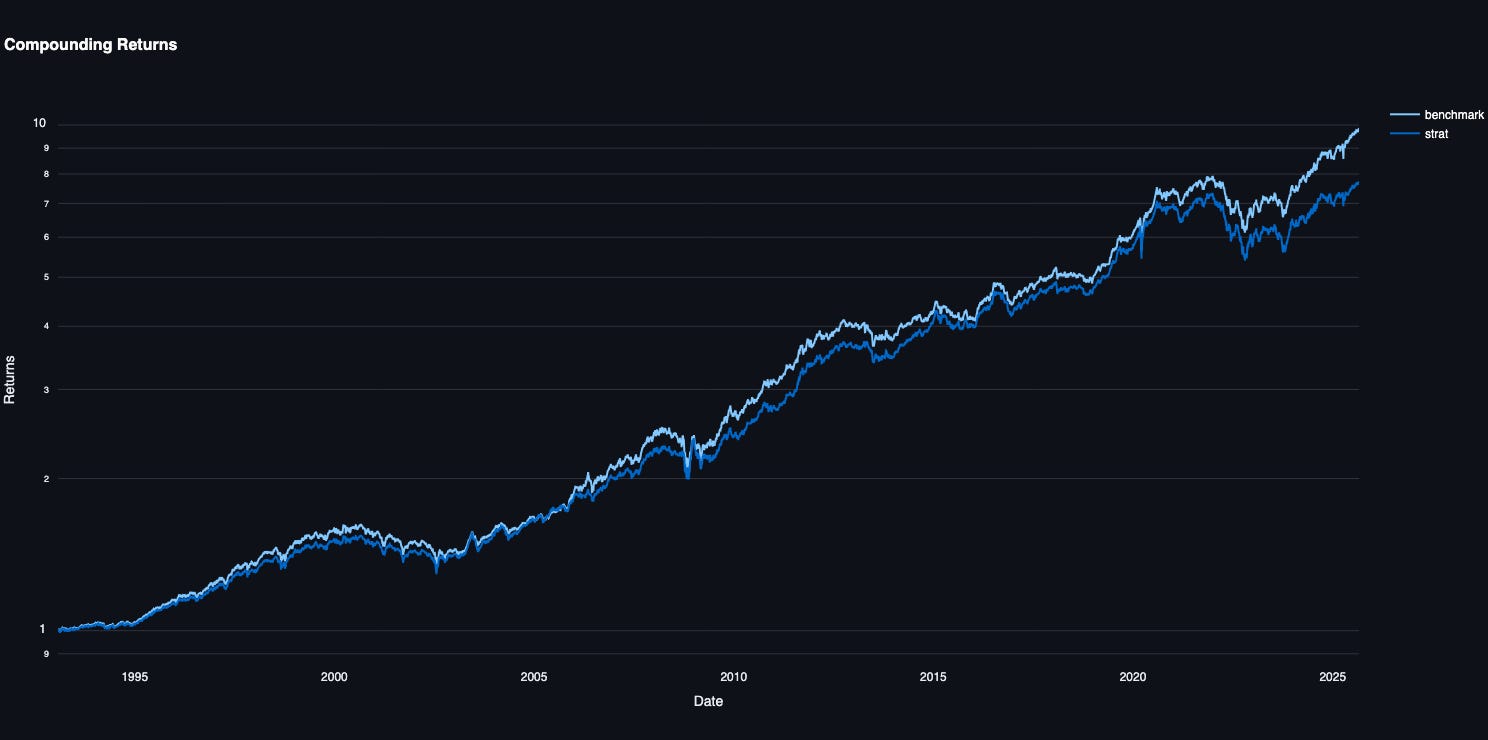
Then around 2008-2010, they started diverging. Not dramatically at first, but consistently. The equal-weight approach began pulling ahead and never looked back.
Where Smart Got Stupid
The 3% That Cost Everything
That tiny difference—30% stocks versus 33%—compounded into a fortune. During one of the longest bull markets in history, I was essentially donating 3 percentage points of equity exposure every single day.
Three percent sounds like nothing. Over 30 years, it's the difference between winning and losing.
Duration Risk Hangover
My 50% allocation to long-term bonds looked brilliant during the bond bull market years. But when interest rates started moving around (hello, 2020s), that duration exposure became dead weight.
The equal-weight approach had 17 percentage points less interest rate sensitivity. Sometimes less is more.
The Bond Overweight Problem
Here's where the barbell really hurt: 50% in long-term bonds versus just 33% in the equal-weight approach. That extra 17 percentage points in TLT became a massive drag, especially during periods when rates were rising or bonds were underperforming.
Ironically, the equal-weight approach actually had more gold exposure (33% vs 20%), which should have been a disadvantage if gold was dead weight. But it was offset by having much less bond duration risk.
The Uncomfortable Truth
What really stings is that I wasn't alone in this "sophisticated" thinking. Risk parity funds, endowment models, smart money everywhere was running variations of the barbell approach. Everyone was too clever for simple equal weighting.
Maybe that should've been my first red flag.
The market doesn't care about your elegant theories if the math doesn't work out. Equal weight won because it had better structural properties for this specific 30-year period:
Higher equity exposure during an equity bull market
Lower interest rate risk during a changing rate environment
Diversification without overthinking it
But Wait, There's More Context
Before you dump all your sophisticated strategies, remember this is one sample of one 30-year period. Different economic regimes could completely flip these results:
High inflation environment? That 20% gold allocation becomes the hero
Major deflation? 50% long bonds provide massive protection
Extended crisis period? The barbell structure might shine
Equal weight won this particular game, but the game changes.
What I'm Taking Away
This test reminded me that sophistication often loses to simplicity—not because simple is inherently better, but because simple is harder to screw up.
My barbell strategy made specific bets about how the economy would evolve. Equal weight made no bets at all. Sometimes making no bets is the smartest bet.
I'm not abandoning thoughtful portfolio construction, but I'm definitely more skeptical of complexity that requires too many assumptions to work.
Your Turn
Have you tested your sophisticated strategies against boring benchmarks lately? The results might surprise you.
I'd love to hear about your own "sophisticated strategy meets simple reality" moments in the comments. We've all been there.
What other allocation tests would you like to see? Reply and let me know what strategies you're curious about.