

Have you ever felt overwhelmed by financial advice that seems to demand massive lifestyle overhauls? I've been there. Eight years ago, I was drowning in debt, living paycheck to paycheck, and the concept of "financial freedom" seemed like a fantasy reserved for trust fund kids or tech entrepreneurs.
Then I discovered what I now call the "1% Rule" – a principle that transformed my financial life through tiny, consistent improvements. Today, I want to share how this approach helped me build a six-figure investment portfolio, eliminate debt, and create multiple income streams – all without extreme sacrifices or get-rich-quick schemes.
What Is the 1% Rule ?
The 1% Rule is simple: focus on improving your financial life by just 1% at a time. This concept, inspired by James Clear's Atomic Habits, applies perfectly to personal finance.
"Success is the product of daily habits—not once-in-a-lifetime transformations." — James Clear
While most financial gurus push for dramatic changes (like cutting all expenses or saving 50% of your income), the 1% Rule acknowledges an important truth: sustainable financial improvement happens gradually through compound effects.
My 1% Journey: From Financial Stress to Freedom
The Breaking Point
In January 2017, I sat at my kitchen table staring at my financial reality:
$42,000 in loans
$8,500 in credit card debt
A savings account with just $843
Monthly expenses that consumed 98% of my income
Conventional advice seemed impossible. I couldn't suddenly save 20% of my income or eliminate all "unnecessary" expenses – I needed a different approach.
The First 1% Changes
I decided to start small. Really small. My first move? Increasing my savings contribution by 50$ per week.
Did I feel financially free overnight? Obviously not. But something important happened: I barely noticed the difference in my daily life, yet I'd taken concrete action.
Encouraged, I looked for another 1% improvement the following month. I negotiated a cheaper cell phone plan, saving $11 monthly – another small win that required minimal effort.
Building Momentum
Month by month, I implemented more 1% improvements:
Month 3: Meal prepped one lunch per week instead of buying out ($8 weekly savings)
Month 4: Canceled an unused streaming service ($13.99 monthly savings)
Month 5: Installed a programmable thermostat (research shows this can save 10% on heating/cooling)
Month 6: Automated an extra $20 bi-weekly toward credit card debt
Month 7: Started using cashback apps for groceries (approximately $15 monthly return)
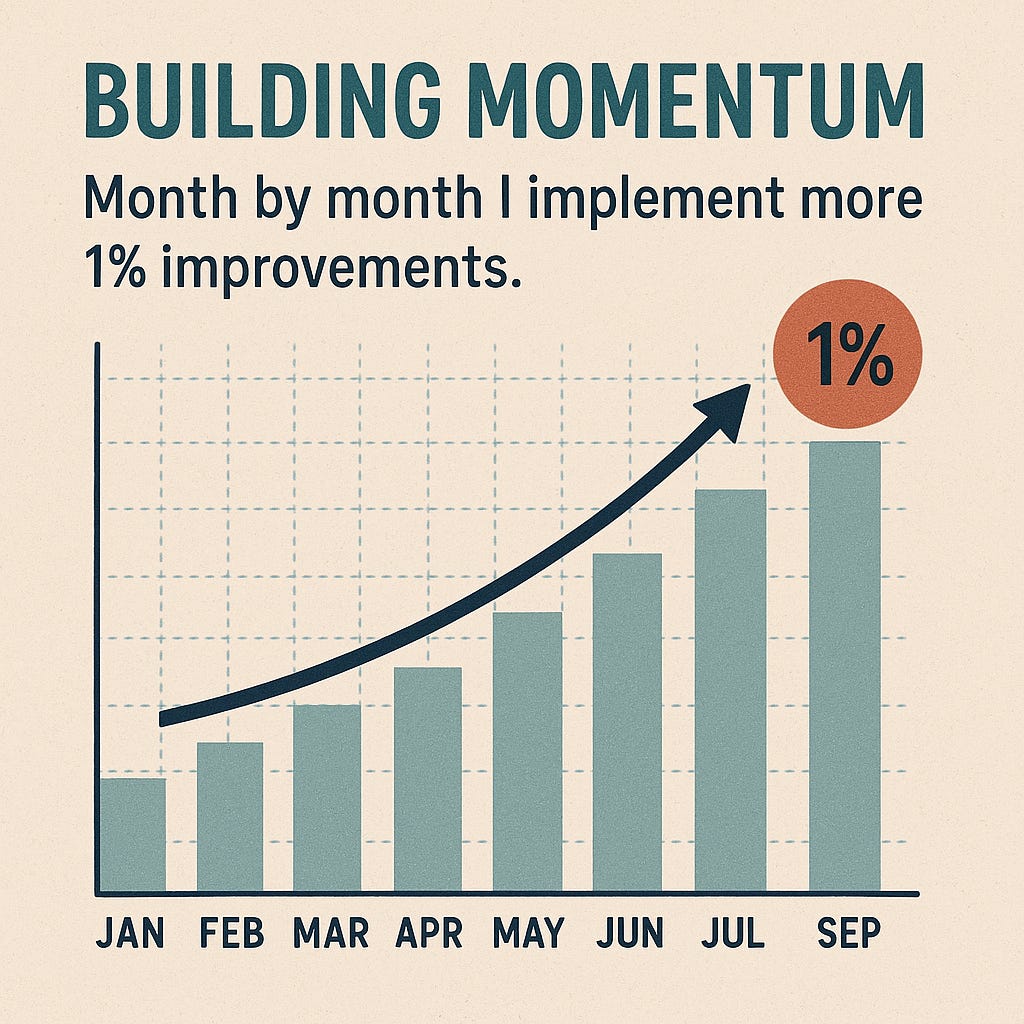
None of these changes were revolutionary. I still enjoyed my life, saw friends, and even took vacations. But the compound effect was beginning to work its magic.
The Math Behind the 1% Rule
Let me show you why small improvements are so powerful. If you improve by 1% daily for a year, you'll end up 37 times better by the end, thanks to compounding:
Conversely, if you get 1% worse each day for a year:
This isn't just theoretical. In my case, 12 months of 1% improvements increased my savings rate from 3% to 16% without lifestyle deprivation.
According to the Trinity Study, each percentage point of savings accelerates your path to financial independence. Increasing your savings rate from 10% to 15% can shave years off your working life.
The Four Financial Areas for 1% Improvements
Through trial and error, I discovered four key areas where small improvements yield significant results:
1. Expense Optimization (Not Deprivation)
The traditional advice of slashing expenses often leads to the "budget bounce" – where extreme restriction causes eventual splurging. Instead, I optimized expenses by:
Implementing a 24-hour rule for purchases over $50
Negotiating just one bill every two months
Trading expensive hobbies for equally satisfying alternatives (hiking groups instead of expensive gym membership)
Using price comparison tools for online shopping
Personal Impact: Within a year, my monthly expenses decreased by $340 without feeling deprived.
2. Income Expansion
Building wealth requires focusing on the income side of the equation. My 1% improvements included:
Taking on a single freelance article monthly in my field
Asking for one additional responsibility at work to position for promotion
Learning one new marketable skill per quarter through free courses
Selling unused items around my home (approximately $100 monthly)
By the 18-month mark, these small steps had increased my income by 22%.
3. Investment Optimization
Many people (including past me) overlook small optimizations that dramatically impact investment returns:
Reducing investment fees by switching to low-cost index funds (saving 0.5% annually)
Increasing saving contributions by 1% every six months
Setting up automatic investments to avoid timing mistakes
Learning about tax optimization through resources like Bogleheads
Personal Result: My investment returns improved by approximately 1.3% annually – which over decades will translate to six figures of additional wealth.
4. Financial Automation
The final piece was removing human error (and willpower) from the equation:
Setting up automatic transfers to savings accounts
Creating bill payment automation to avoid late fees
Implementing account balance alerts to prevent overdrafts
This system ensured consistent progress regardless of motivation or memory.
Creating Your Own 1% Plan
Ready to implement the 1% Rule in your financial life? Here's how to start:
Step 1: Financial Snapshot
Take an honest inventory of your current situation:
List all income sources
Track expenses for 30 days
Calculate your savings rate
List debts with interest rates
Review investment accounts and fees
Step 2: Identify Your First 1%
Look for one small, immediate improvement you can make this week. Remember, it should be:
Sustainable (something you can maintain)
Nearly painless (minimal lifestyle impact)
Measurable (you can track the result)
Step 3: Calendar Your Improvements
Create a 12-month calendar with one 1% improvement scheduled for each month. This prevents overwhelm while ensuring consistent progress.
Step 4: Track and Celebrate
Keep a simple spreadsheet or journal of your improvements and their cumulative impact. Celebrating small wins activates your brain's reward system and builds momentum.
Common Objections to the 1% Approach
When I share this strategy, I often hear:
"1% is too small to matter!" This ignores the power of compounding. Small changes stacked over time create remarkable results. Would you rather make a dramatic 20% improvement that lasts two weeks or a 1% improvement you can maintain for years?
"I need results now!" Financial freedom is not an overnight process for most people. The 1% Rule delivers sustainable results that actually last, unlike crash financial diets.
"I've tried everything already." Have you truly optimized every area of your financial life by 1%? Most people have significant room for improvement in areas they haven't considered.
My Results After Three Years
Implementing the 1% Rule for three consecutive years has completely transformed my financial reality:
Loans: Decreased from $42,000 to $0
Credit card debt: $0 (eliminated within 14 months)
Emergency fund: Increased from $843 to $15,000
Investments: Built a six-figure portfolio
Income streams: Expanded from one to four
Stress level: Dramatically reduced
Most importantly, I achieved this without extreme measures or feeling deprived. I still travel, enjoy dinners with friends, and pursue my hobbies – I just do it all with strategic intention.
Start Your 1% Journey Today
Financial freedom isn't about making perfect decisions or dramatic sacrifices. It's about consistent, sustainable improvements that compound over time.
What 1% improvement will you make today? Share in the comments below, and let's build financial freedom together – one small step at a time.