

Contents
My Risk Parity Discovery
When I first started investing, I was completely overwhelmed by the number of strategies out there. Should I go all-in on stocks ? Build a 60/40 portfolio? Follow what Reddit was recommending that week ? It wasn’t until I stumbled upon Risk Parity that I found an approach that really resonated with my investment philosophy.
Risk parity isn’t your typical investment strategy that obsesses over expected returns. Instead, it’s about something I’ve come to value much more: balanced risk. After watching my portfolio take wild swings during market volatility. I realized that proper risk management was what I had been missing all along.
The beauty of risk parity is how it distributes risk evenly across your portfolio components. Unlike traditional methods where I’d allocate 60% to stocks regardless of their volatility, risk parity taught me to think differently. I learned to allocate capital based on risk contribution, which has completely transformed how I view portfolio construction.
Trading Rules I Follow
Through trial and error, I’ve developed a systematic approach to risk parity that works for my personal investment goals. Here’s how I implement it:
a. Measuring Risk in My Portfolio
I start by calculating the volatility of each asset in my portfolio using historical price data. This gives me a clear picture of how much each investment tends to fluctuate. For example, when I analyzed SPY (S&P 500 ETF) . I found its volatility significantly higher than my bond ETFs, which informed my allocation decisions.
b. Understanding Correlation
Next, I create a correlation matrix to understand how my assets move in relation to each other. This was eye-opening for me! I discovered that some assets I thought provided diversification actually moved in tandem during market stress. Tools like Portfolio Visualizer have been invaluable for this analysis.
c. Setting the Right Weights
Using these volatility measurements and correlations, I assign weights to ensure each asset contributes equally to my portfolio’s overall risk. This means my higher-volatility assets (typically stocks) get lower weights than more stable investments like treasury bonds. This balanced approach has helped me sleep better at night during market turbulence.
d. My Rebalancing Schedule
Markets change, and so does my portfolio. I’ve found that quarterly rebalancing works best for me, allowing me to maintain my target risk distribution without excessive trading costs. During periods of extreme volatility, I’ll sometimes perform an additional rebalance if asset relationships dramatically shift.
How I Implemented Risk Parity in Python
As someone who loves to code, I built my own risk parity implementation in Python. This gave me complete control over my strategy and helped me understand the mathematical concepts on a deeper level.
Here’s the approach I took:
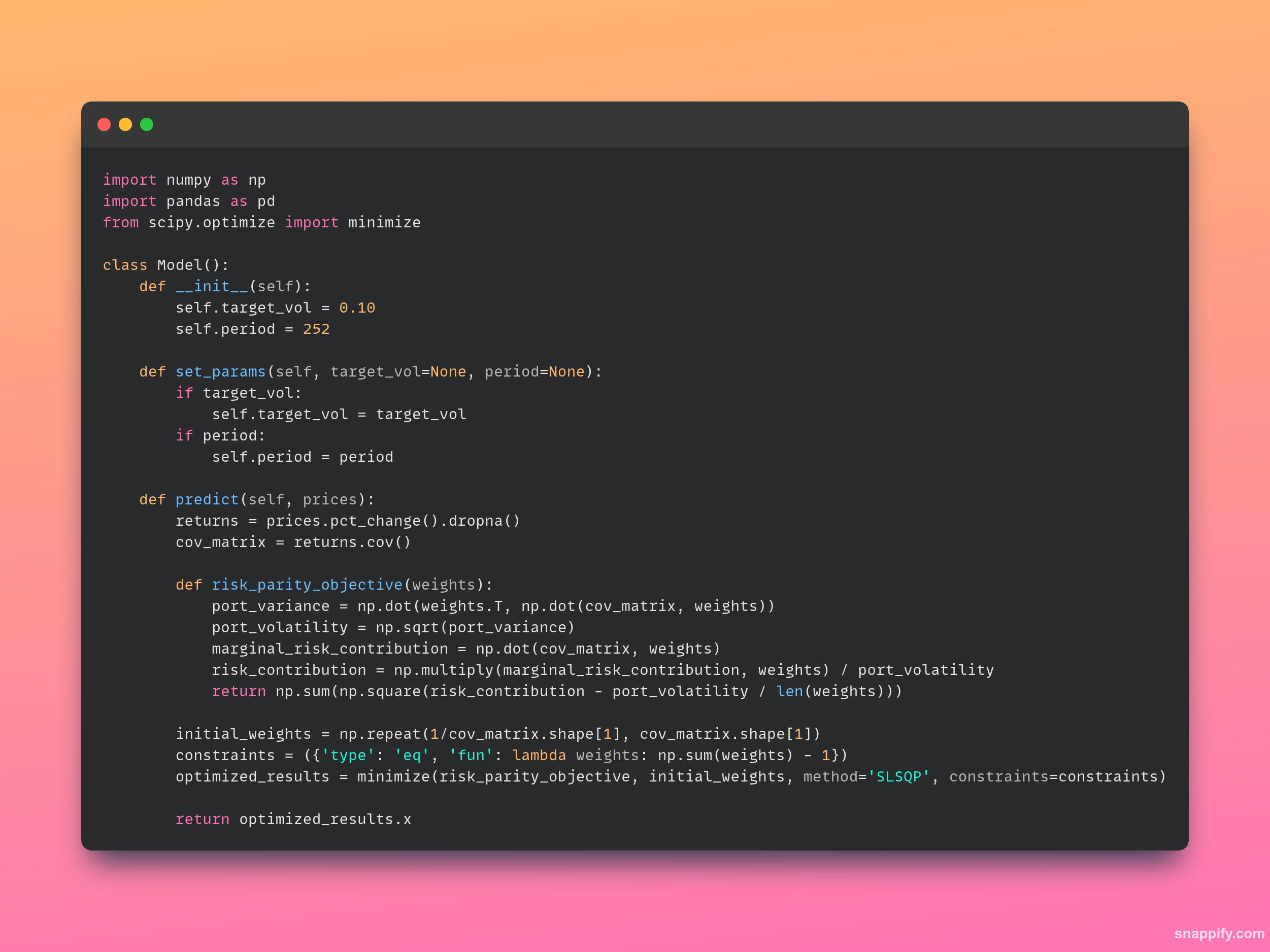
The mathematical foundation behind my implementation aims to equalize risk contribution across assets. If I denote my portfolio weights as w and the covariance matrix as C, then the portfolio variance is:
For each asset, I calculate its risk contribution as:
My goal is to find weights that make all RC_i equal, which I achieve through optimization.
I've integrated this code with yfinance to fetch historical data and Matplotlib for visualization, creating a complete system that handles everything from data collection to portfolio optimization.
Results
I tested my Risk Parity implementation on a portfolio of three assets that I personally invest in: SPY (S&P 500), TLT(long-term Treasury bonds), and GLD (gold).
The results were fascinating and sometimes counterintuitive! My Risk Parity portfolio achieved a 7.17% Compound Annual Growth Rate (CAGR), which was slightly lower than the 7.32% from a simple equal-weight approach. However, the Risk Parity approach reduced my portfolio volatility to 9.13% compared to 9.44% with equal weighting.
What surprised me most was the maximum drawdown. Despite lower volatility, my Risk Parity portfolio experienced a slightly worse maximum drawdown of -22.47% compared to -21.22% for the equal-weight portfolio. This taught me an important lesson: reduced day-to-day volatility doesn't always translate to better protection during major market crashes.
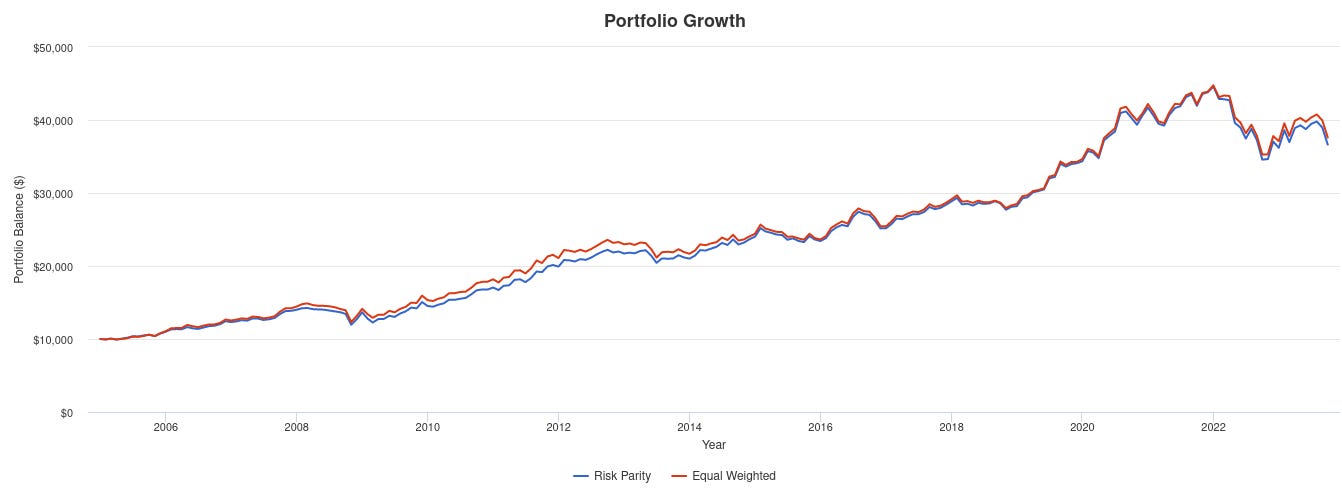
The Sharpe Ratio, which measures risk-adjusted returns, was marginally better for Risk Parity at 0.66 versus 0.65. While this difference is small, it confirmed that I was being compensated appropriately for the risks I was taking.

These results challenged my assumptions about Risk Parity. Rather than seeing it as a silver bullet, I've come to view it as one valuable tool in my investment toolkit, particularly effective in certain market environments.
Final Thoughts on My Risk Parity Journey
My experience with Risk Parity has been both enlightening and humbling. While it hasn't dramatically outperformed simpler strategies in terms of raw returns, it has given me a more nuanced understanding of risk management that has improved my overall approach to investing.
The slight improvement in Sharpe Ratio suggests that Risk Parity does deliver on its promise of better risk-adjusted returns, but the margins are thin. I've learned that no strategy is perfect, and each comes with its own set of tradeoffs.
For my personal investing journey, the most valuable lesson has been understanding that different strategies work better in different market environments. During periods of stable correlations between asset classes, Risk Parity has performed admirably. However, during systemic crises when correlations spike, its benefits can diminish.
I've also come to appreciate the importance of considering practical aspects like transaction costs, tax implications, and the psychological comfort of my investment approach. A theoretically optimal strategy that causes me stress or leads to emotional decision-making won't serve me well in the long run.
If you're considering implementing Risk Parity in your own portfolio, I recommend starting with a small portion of your investments and gradually increasing allocation as you become comfortable with the approach. Tools like Portfolio Visualizer can help you backtest and understand how Risk Parity might have performed historically with your specific asset mix.
Ultimately, the best investment strategy is one that aligns with your goals, risk tolerance, and investing temperament. For me, Risk Parity has been a valuable part of that journey, teaching me to think more deeply about risk and diversification in ways that have made me a better investor overall.
Have you experimented with Risk Parity or other risk-based allocation strategies? I'd love to hear about your experiences!
Related Articles You Might Enjoy: