

Drag the savings-rate slider on any FIRE calculator and watch the magic happen. 20% to 50%, and your freedom date jumps forward by a decade. It feels like discovery. It feels like the secret.
It’s a trap. And the more disciplined you are, the deeper it pulls you in.
Here’s the heresy: frugality is the weakest lever in personal finance, and FIRE built an entire religion around pulling it.
The floor and the ceiling
Frugality is subtraction. Income is multiplication.
You cannot subtract below zero. There is a hard floor under your spending — rent, food, the minimum cost of being a person — and every euro you claw back gets harder to find than the last. The first cut is easy. The tenth requires you to cancel things that make life worth living.
Income has no ceiling. None. The only cap is the effort you stop putting in.
So the movement took its most motivated, highest-discipline people and pointed them at the lever with a floor, while telling them to ignore the lever with no ceiling. That’s not strategy. That’s a personality test the movement is failing on your behalf.
Two people, three years
Both earn €40k net. Both spend €30k. Both save 25%.
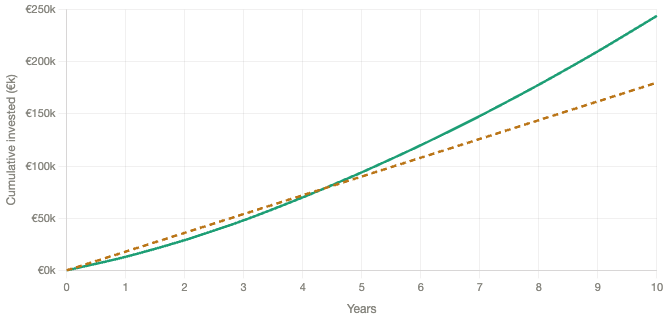
Person A becomes a frugality monk. Smaller flat, no car, every receipt audited. Three years later they’ve crushed spending to €22k. Savings rate: 45%. The community gives them a standing ovation.
Person B ignores the budget and gets better at getting paid. Switches roles twice, builds a scarce skill, lifts income to €60k. Lets spending drift up to €34k because life is short. Savings rate: 43% — slightly worse on paper.
The calculator frowns at Person B.
The calculator is an idiot.
Person A saves €18k a year. Person B saves €26k a year. Person B hits independence first, lives better the entire way there, and — here’s the part nobody shows you — Person B’s savings rate keeps climbing on its own, because €34k against a rising income shrinks as a percentage every single year without one more sacrifice.
Person A has nowhere left to cut. Person B has nowhere they have to.
Why the lie is so comfortable
If income is the stronger lever, why does the whole movement worship the weaker one? Three reasons, none of them mathematical:
Frugality is instant and certain. Cancel a subscription this afternoon, feel the win tonight. Raising your income is slow, uncertain, and involves other people telling you no. We pick the small sure thing over the big scary thing every time.
Frugality looks like rigor. A spreadsheet tracking every euro to four decimals feels like science. But precision isn’t leverage. You can measure the wrong number perfectly.
Frugality feels holy. Spending less reads as virtuous. Earning more reads as greedy. So the community quietly applauds the coupon-clipper over the person who negotiated a €20k raise — even though the second person did ten times more for their own freedom.
We optimized for what’s measurable and moral instead of what works.
The part that’s actually true
I’m not telling you to spend like an idiot. Your number is still your spending times 25, and lowering it still helps. The first cleanup — dragging a chaotic budget down to a deliberate one — is the highest-return move most people will ever make, and it barely costs you anything. Do that part ruthlessly.
But the diminishing returns arrive way earlier than FIRE admits. Going from a deliberate budget to a punishing one buys almost nothing and costs you everything that matters: the energy, attention, and risk appetite you need to grow income. It also makes the whole project feel like deprivation — which is exactly why most people quit before they finish.
So: cut the waste once, hard and early. Then stop fighting on spending and throw that same intensity at the lever with no ceiling.
Defend the floor. Then go raise the roof.
What a good year actually looks like
Under the frugality religion, a good year is one where spending fell. A smaller life, celebrated.
Under the real math, a good year is one where the gap between what you earn and what you spend got wider — and the healthiest way to widen a gap is to lift the top line, because that gap can grow forever without your life ever getting smaller.
The mathematics of freedom were never about how little you can survive on. They’re about the size and durability of the gap, and about which side of it you can move the furthest.
For almost everyone, that side is income.
The slider just never let you drag it.
Deliberately provocative to make a point about trade-offs — not personalized advice. Run your own numbers; the right mix of cutting and earning depends on your situation, market, and stage.